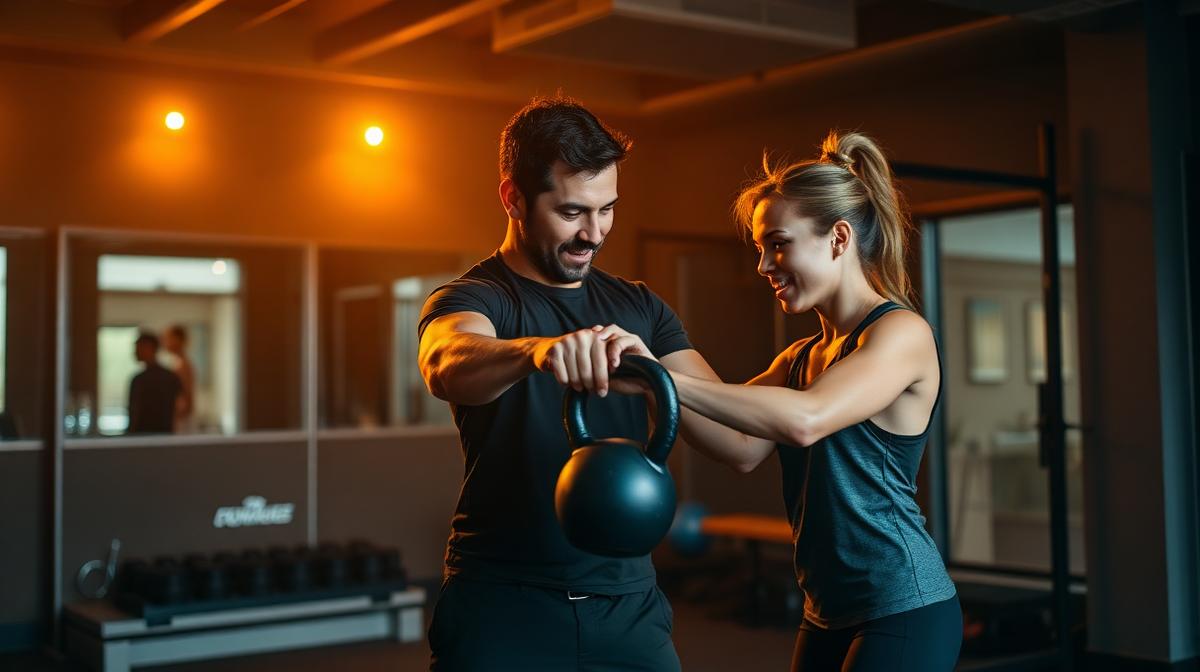
Let's be honest: when most of us think about "lifting weights," we picture a 22-year-old guy named Chad standing in front of a mirror, veins popping, doing his 47th set of bicep curls while checking his reflection. That's traditional bodybuilding. It's all about aesthetics, building muscle for the sake of looking like a Greek god (or at least someone who doesn't skip leg day).
But then you hit 40.
Suddenly, your lower back makes a "rice krispies" sound when you get out of bed. Your knees have an opinion on the weather. And honestly? You don't care as much about having a six-pack as you do about being able to hike with your kids, carry all the groceries in one trip, and not feel like you need a nap after mowing the lawn.
This is where the debate begins: Functional Strength vs. Traditional Bodybuilding.
If you're looking for a personal trainer in Woodstock or Kennesaw, GA, or trying to figure out which "flavor" of fitness will keep you out of a nursing home and in the driver's seat of your life for the next 40 years, you've come to the right place. Let's cut through the noise and look at what actually works for longevity.
The Show Muscle Trap: Why Bodybuilding Isn't Always the Answer
Traditional bodybuilding is focused on hypertrophy, making individual muscles bigger. It involves a lot of "isolation" movements. Think leg extensions, cable flyes, and tricep pushdowns.
Don't get me wrong; muscle mass is vital. In the science world, we talk about sarcopenia, which is just a fancy way of saying your muscles start to pack their bags and leave as you age. After age 30, you can lose 3% to 8% of your muscle mass per decade. By the time you're 70, you could be half the person you used to be, literally.
But here's the kicker: having huge biceps doesn't necessarily mean you can move well. You can have "show muscles" that look great in a polo shirt but "go muscles" that fail you the moment you have to move in a way that isn't a straight line. Traditional bodybuilding often ignores:
- Balance and Stability: Life doesn't happen on a guided machine rail.
- Multi-planar Movement: We move side-to-side and we rotate. Bodybuilding is often very linear.
- The Core: And no, I don't mean "abs." I mean the 360-degree cylinder of muscle that keeps your spine from turning into a question mark.
What is Functional Strength Training, Anyway?
Functional strength training is about training movements, not muscles.
Instead of sitting on a machine to work your quads, you do a squat. Why? Because you squat every time you sit in a chair or get off the toilet. Instead of doing a bicep curl, you might do a weighted carry. Why? Because you carry suitcases, toddlers, and mulch bags.
Functional training focuses on the "Big 6" patterns:
- Squat: (Getting up)
- Hinge: (Picking things up)
- Push: (Moving things away)
- Pull: (Bringing things to you)
- Lunge: (Stepping and climbing)
- Carry: (Moving under load)
For adults over 40, functional strength training is the "Amazon Prime" of fitness, it delivers exactly what you need, right when you need it.

The Longevity Science: Why Your Joints Will Thank You
Let's talk about "Joint Debt." If you spent your 20s ego-lifting, chasing heavy bench press numbers with terrible form, you're likely paying the interest on that debt now.
Traditional bodybuilding often pushes muscles to total failure. While that's great for growth, it can be brutal on your tendons and ligaments if you aren't careful. Functional training, especially the way we program it here at Hive, prioritizes joint integrity.
1. Power vs. Strength
Strength is how much weight you can move. Power is how fast you can move it. Guess which one we lose faster as we age? Power.
Functional training incorporates "power" movements, like a kettlebell swing or a fast step-up, that keep your fast-twitch muscle fibers alive. These are the fibers that save you from a fall when you trip over the dog. A leg extension machine won't help you catch your balance; a functional hinge pattern will.
2. Sarcopenia Protection
You need muscle mass to live longer. Period. Studies show that higher muscle mass is linked to better insulin sensitivity, higher bone density, and lower all-cause mortality. The good news? You don't need to train like a bodybuilder to get it. High-intensity functional training builds plenty of "armor" (muscle) to protect your bones.
3. Mobility is Not Stretching
People think mobility means being able to touch your toes. It doesn't. Mobility is strength in range. It's being able to control your body while it's moving. Functional training forces your joints to work together (inter-regional coordination), which keeps them "greased" and healthy.

The Hybrid Approach: The Hive Way
I'm going to let you in on a secret: It's not an "either/or" situation.
The best program for longevity after 40 is a "Hybrid." You want the functional movements as your foundation, but you also want a little bit of that bodybuilding "accessory" work to fix your weak links.
If your posture is sagging because you sit at a desk all day in Woodstock or Kennesaw, we're going to give you some functional rows (pulling), but we might also throw in some "bodybuilding" face pulls to strengthen those tiny muscles in your upper back that keep your shoulders from rolling forward.
We call this Smart Programming. We aren't just throwing random exercises at a wall to see what sticks. We're building a body that can handle a 5-mile hike on Saturday and a 10-hour work day on Monday without needing a bottle of Advil.
Why Group Coaching Beats Going Solo
Look, you could try to figure this out yourself. You could go to a big-box gym, stare at the "functional turf" area for ten minutes, and then retreat to the safety of the treadmill.
Or, you could join a semi-private training session.
When you're over 40, the margin for error is smaller. You can't afford a "oops, I blew out my back" moment. Having a coach who understands injury prevention and can modify a movement on the fly to fit your body is the difference between progress and physical therapy.

Real Talk: The "Dad Bod" and Metabolic Health
We can't talk about longevity without mentioning nutrition. You can do all the functional squats in the world, but if you're face-deep in a box of donuts every morning, your heart won't care how much you can kettlebell swing.
Functional strength training is metabolically demanding. It burns more calories per minute than isolated bodybuilding because you're using more muscles at once. It's like the difference between running a single lightbulb and turning on the whole house.
Combine that with a habit-based nutrition plan, and you've got the recipe for staying lean, strong, and capable well into your 60s, 70s, and beyond.
Your Longevity Checklist
If you're ready to stop training like a kid and start training for your future, here's your starter kit:
- Prioritize Compound Movements: If you can do it sitting down, try doing it standing up.
- Focus on the Hinge: Learn to use your glutes and hamstrings to save your lower back.
- Don't Fear the Heavy Stuff: You don't need to be a powerlifter, but you do need to challenge your bones to keep them strong.
- Get a Coach: Especially if you're getting back into it after a layoff. Form is everything.

Ready to Build a Body That Lasts?
At Hive Fitness Journey, we don't care about your "max bench." We care about your "max life."
We specialize in helping adults 30-55 reclaim their strength, mobility, and confidence through personalized group coaching. No judgment, no "meathead" culture: just a supportive community of people who want to move better and live longer.
Stop guessing and start progressing. Check out our session schedule or contact us today to see how we can tailor a functional strength plan specifically for you.
Your future self is already thanking you.